Bhuloka
Description
The earthly realm of human life — of action (karma) and free will.
Systems interpretation
Our current operating environment: 1 g gravity, atmosphere, biology — where most workloads of life run by default.
Multi-Environment Civilization Framework
How humanity evolves by optimizing work across environments.
A framework by Venkat Namala
Not just how to do the work — but the environment best suited to it. That single shift, repeated across history, is what this framework traces.
Different Environments
Each place has its own physics.
Different Constraints
Limits differ from place to place.
Different Capabilities
New limits unlock new abilities.
Different Opportunities
Ability becomes advantage.
Different environments create different constraints, which unlock different capabilities, which open different opportunities.
Different environments create different constraints, which unlock different capabilities, which open different opportunities.
Nature does not optimize life for one place. Each biome imposes its own constraints — and life answers each with a different strategy.
Vast, buoyant, nutrient-layered.
The same five axes for every biome — water, temperature, pressure, light, and biodiversity — so a lopsided signature shows exactly where life had to specialize.
Each shape is one environment on the same five axes — a bigger spoke means more of that resource.
Vast, buoyant, nutrient-layered.
Scarce water, extreme temperature swings.
Warm, wet, and fiercely competitive.
Thin air, steep gradients, rapid change.
Cold, bright-then-dark, ice-bound.
No sunlight, crushing pressure, chemical energy.
Open, mobile, energy-rich but resource-thin.
Same five axes everywhere — so a lopsided signature shows exactly where life had to specialise to survive.
7 biomes · 5 shared axes
One historical example of multi-environment thinking appears in Hindu cosmology, where reality is described through multiple lokas, or realms. This is presented here as a conceptual framework, not as a scientific model.
The earthly realm of human life — of action (karma) and free will.
Our current operating environment: 1 g gravity, atmosphere, biology — where most workloads of life run by default.
Read as an interpretive analogy — a way to line up two vocabularies for “many environments, each with its own rules,” not a claim that ancient texts describe modern physics.
A distinct domain with its own conditions — gravity, temperature, radiation.
The governing rules and limitations that hold within a domain.
Action produces results under specific conditions.
Capability progresses in cycles over long time horizons.
Periodic restructuring that clears the way for new growth.
A bounded whole within which everything is conserved.
The medium in which all processes take place.
Described agencies that map to forces such as gravity and electromagnetism.
The basic elements from which all matter is composed.
The Pancha Mahabhutas, or five great elements — read as a pre-scientific taxonomy of what every environment is made of: states of matter, energy, and the space they occupy.
Earth
Solid structure and mass — the ground a system is built on.
Water
The liquid state — a medium for transport and reaction.
Fire
Energy and transformation — the heat that drives change.
Air
The gaseous state — motion, flow, and pressure.
Space / Aether
The space-time framework — the medium all processes occur in.
Every environment — natural or engineered — is defined by its temperature, water, pressure, energy, and the strategies that thrive there. The same lens now moves from biology to technology.
Temperature
Sets the pace of every reaction and process.
Water / Fluid
Availability shapes what can be transported and built.
Pressure
Determines what states of matter are stable.
Energy
The budget every system spends to do work.
Biodiversity / Diversity
How many distinct strategies coexist.
Adaptation strategy
The winning response to local constraints.
Cloud computing became powerful precisely because work could be placed — by region, by zone, by edge — wherever it served best.
Each era zoomed the boundary out — one machine, one building, one geography, many geographies — until the edge folded it back into thousands of places at once.
zoom out ▸ boundary widens each era ▸ then edge inverts it — reach stays global, but compute scatters back to the ends
reach · 1 machine
All work happens in one place, on one box.
Origin point — simple, but a single environment and a single failure domain.
reach · Thousands of machines
Many machines pooled in one building with shared power and cooling.
Concentration of capacity — still one geographic environment.
reach · Multiple facilities
A geographic area containing several isolated data centers.
Introduces the idea of placing work in a chosen location.
reach · Global
Work spread across regions for resilience, latency, and reach.
Compute becomes many environments chosen deliberately.
reach · Everywhere
Compute pushed close to users and devices at the network edge.
The environment is selected per-request, as close to the work as possible.
Availability Zones
Region-local
Isolated failure domains within a region.
Resilience through environmental separation.
GPU Nodes
Accelerated
Massively parallel processors for training and rendering.
The right environment for parallel numerical work.
Storage Nodes
Persistent
High-capacity, durable data environments.
The right environment for keeping state.
Edge Locations
Distributed
Small points of presence near end users.
The right environment for low latency.
Kubernetes formalizes the question. Given a workload's needs and each node's capabilities, the scheduler places work in the environment that fits. Try it below.
GPU node
GPU Node
8× GPU · 96 vCPU
CPU node
CPU Node
64 vCPU · 256 GB
Storage node
Storage Node
16 vCPU · 24 TB NVMe
Memory node
Memory Node
32 vCPU · 1 TB RAM
Edge node
Edge Node
8 vCPU · near users
Requests / limits
why this node
Model training needs massively parallel GPUs; the pod tolerates the gpu taint to land here.
why not the others
pending queue — click or tab + enter to schedule
AI performance depends on matching the model and workload to the right compute environment — from flexible CPUs to massively parallel accelerators.
Central Processing Unit
Best forFlexible, sequential, general-purpose logic.
Trade-offFew powerful cores — limited parallel throughput.
Graphics Processing Unit
Best forMassively parallel training and dense math.
Trade-offHigher power draw; needs parallelizable work.
Tensor Processing Unit
Best forLarge-scale tensor operations in the datacenter.
Trade-offSpecialized — best within its target frameworks.
Neural Processing Unit (Edge)
Best forOn-device inference at very low power.
Trade-offSmall models; limited memory and compute.
Managed Inference Service
Best forElastic serving of models to many users.
Trade-offNetwork round-trip; ongoing operating cost.
Distributed Training Cluster
Best forTraining frontier models across many accelerators.
Trade-offExpensive; coordination and interconnect are hard.
The same comparison, now across physical worlds. Each environment offers a distinct mix of gravity, pressure, radiation, and resources — and therefore a distinct manufacturing potential. Select a row to explore.
Illustrative values for orientation, not engineering figures. Read a column top-to-bottom to feel a place; the warmer the cell, the more extreme the property.
| Property ↓ / Env → | Earth | Low Earth Orbit | Moon | Mars | Asteroids | Deep Space |
|---|---|---|---|---|---|---|
| Gravityg-level | 1 g | Micro-g (free fall) | ~0.16 g | ~0.38 g | Negligible | Near-zero |
| Atmospheregas shell | Thick | Near-none | None | Thin (CO₂) | None | None |
| Pressureambient | ~1 atm | Near-vacuum | Vacuum | Very low | Vacuum | Vacuum |
| Radiationdose | Low (shielded) | Elevated | High | High | High | Very high |
| Temperaturestability | Moderate | Extreme swings | Severe swings | Cold | Cold | Near absolute zero |
| Vacuumquality | None | High | Full | Near | Full | Full |
| Resourcesin-situ | Abundant | Launched / solar | Regolith, ice | Regolith, water ice | Metals, volatiles | Scarce |
Earth
Mature: gravity-assisted processes, dense supply chains, easy human access.
Low Earth Orbit
Emerging: sustained microgravity plus reachable return — the focus of orbital manufacturing today.
Moon
Prospective: low gravity, vacuum, and regolith resources for in-situ construction.
Mars
Long-horizon: thin atmosphere and local materials for in-situ resource use.
Asteroids
Speculative: concentrated metals and volatiles in negligible gravity.
Deep Space
Frontier: stable microgravity and vacuum, but far from supply and return.
Values are approximate and illustrative — for visual comparison only, not to scale.
Orbital manufacturing reframes the question — from how to build something on Earth, to where its ideal conditions actually exist.
The old question
“How do we manufacture this on Earth?”
Gravity is a constant to fight — settling, convection, containers, defects. The floor is fixed; you optimize around it.
The orbital question
“Where is the best environment to manufacture this?”
Gravity becomes a dial. Choose micro-g, vacuum, or deep cold as an input — then bring the product home.
Each environment enables a different class of products. These are illustrative, well-studied areas of interest — not claims about any specific company or product.
1 g · dense supply chains
Microgravity · vacuum · returnable
Partial gravity · local resources
Negligible gravity · full vacuum
Varda Space represents a new kind of industrial platform — not space as a destination, but space as an operating environment.
Varda's model is environment-aware manufacturing: identify products or processes that benefit from microgravity, manufacture in orbit, and return the product to Earth.
Identifyon Earth
Find products or processes that benefit from microgravity.
Manufacturein orbit
Perform the process in orbit, in its ideal environment.
Returnto Earth
Bring the finished product back to Earth for use.
Presented at a high level as an illustrative example of environment-aware manufacturing. No specific technical or commercial claims are implied.
The framework is not only a metaphor. It is the daily discipline of Site Reliability Engineering — deciding where each workload runs, proving it stays healthy, and carrying changes safely from a laptop all the way to a spacecraft you cannot SSH into.
Cloud, ground, edge, and orbit are one continuous operating surface. Infrastructure as Code and GitOps make each environment reproducible; CI/CD carries a change across all of them.
Kubernetes and Slurm answer the same question for different workloads — long-running services versus dense parallel compute. Both place work where it fits.
Scheduling
Kubernetes and Slurm answer the same placement problem from opposite ends of the compute spectrum. Read each row across the spine.
| Dimension | Kubernetes | Slurm |
|---|---|---|
| Primary workload | Long-running services | Batch & HPC jobs |
| The question | Where should this pod run? | Where should this job run? |
| Placement by | Labels, taints, affinity | Partitions & queues |
| Fairness | Requests, limits, quotas | Fair-share scheduling |
| Accelerators | GPU node pools | GPU/QoS partitions |
| Scales for | Elastic microservices | Dense parallel compute |
You cannot watch a capsule over your shoulder. Reliability is defined as a budget, observed remotely through metrics and traces, and defended with actionable alerting and blameless postmortems.
Define reliability as a target, then spend the remaining budget on velocity. The budget decides when to ship and when to stabilize.
Instrument everything. Time-series from services and vehicles feed dashboards that surface trouble before users — or missions — feel it.
Follow a request across services to find where latency and errors actually originate in a distributed system.
Page a human only when a human must act. Alerts map to symptoms users feel, each with a clear runbook.
Detect, mitigate, then learn. Root-cause analysis drives durable fixes rather than blame.
Find bottlenecks, tune performance, and design for graceful degradation so a partial failure never becomes a total one.
Reliability is a number you choose, then defend. Drive the error rate and watch the budget burn, the multi-window alerts trip, and the ship/freeze decision flip — the same math an on-call engineer lives by.
Burn rate 0.50× · 22 of 43 budget-minutes consumed this 30-day window.
You cannot shell into a capsule at 7 km/s. Step through an incident and watch mean-time-to-acknowledge and mean-time-to-recover accrue as autonomy and on-call carry it to a blameless postmortem.
Ground station link drops packets; capsule telemetry gaps widen.
healthyT+0 min
Nominal — SLO within budget
The building blocks that turn these principles into an operable platform across environments.
IaC & config
Orchestration
CI/CD & GitOps
Observability
HPC scheduling
Cloud & network
One console over the same engines: live-style telemetry, error-budget burn, and an anomaly that recovers autonomously — because at orbital velocity, reliability is designed in, not shelled in.
LEO 512 km
LEO 480 km
SSO 560 km
Illustrative telemetry and figures. The console reuses the same error-budget and incident engines shown above — one core, several views.
The companion slide deck — from ancient cosmology to orbital manufacturing. View it live below, or download the original PowerPoint.
From Ancient Cosmology to Orbital Manufacturing
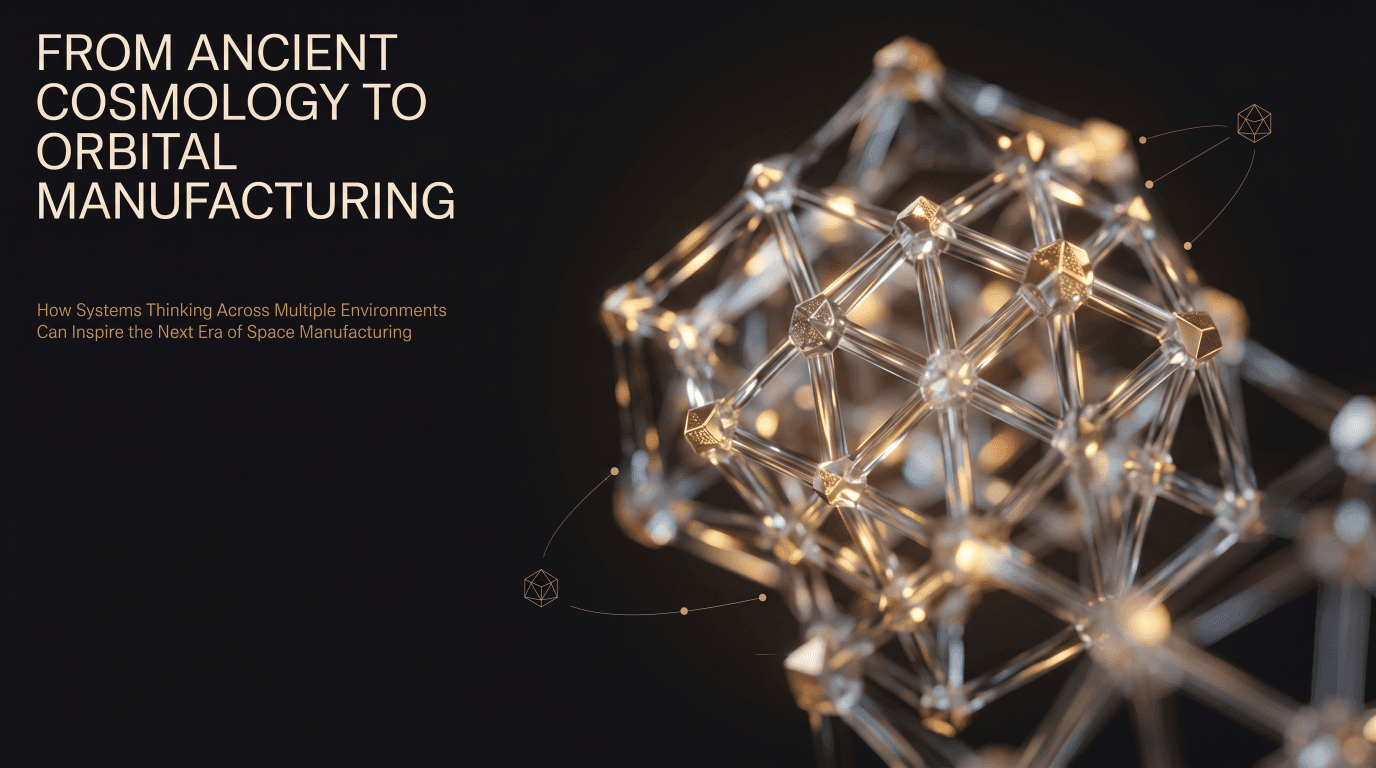 1 / 24
Showing exported slides. The live embedded PowerPoint viewer activates automatically on the deployed site — or download the original .pptx above.
Ancient frameworks, biomes, cloud, Kubernetes, AI, orbital manufacturing, future civilization — click any node and the pattern repeats: environment, constraint, capability, workload, outcome.
Civilization may evolve from a single-planet system into a distributed multi-environment network — each industry operating where it works best. Select an industry to see where.
Select an industry to light the environment(s) whose physics it exploits — or hover an orb to raise its corridors.
“The next industrial revolution may not come from building better factories alone. It may come from choosing better environments.”